Guide
How to increase your repeat purchase rate on Shopify
 By Dr. Nisarg Patel, MobiVogue Updated
The short answer
To increase your repeat purchase rate, win the second order. Time a reminder to when the product runs out, make reorder one tap, offer a subscription on products used every day, and fix whatever disappointed first-time buyers. Start with the first month after a first order, when second orders cluster.
What repeat purchase rate is, and how to find yours
Repeat purchase rate is the share of customers who ordered more than once in a period, usually 12 months: customers with two or more orders ÷ all customers who ordered × 100.
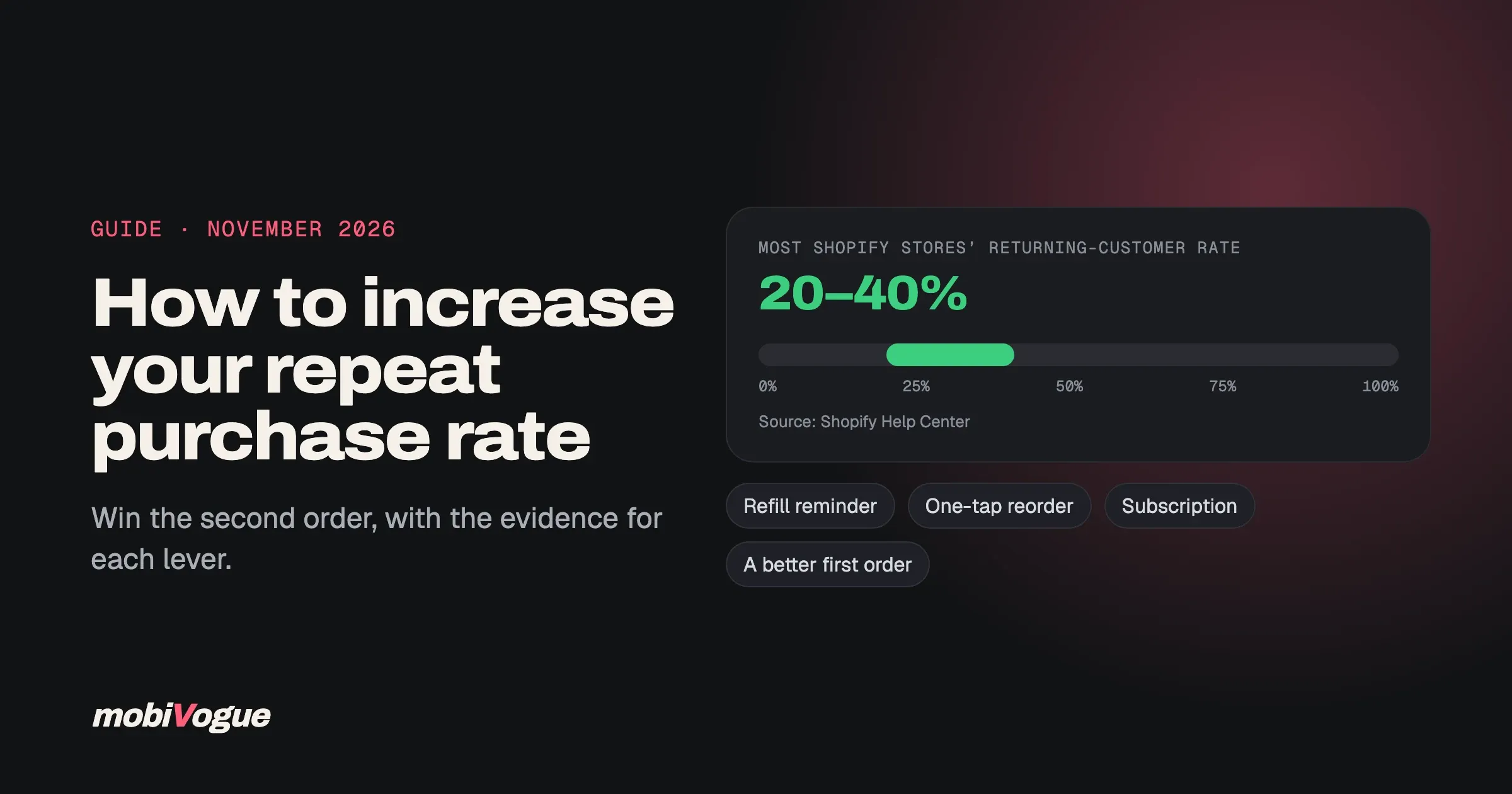
Shopify reports something different. Its returning customer rate is “returning customers / customers”, where a returning customer is one whose order history already includes at least one order, at any time. Because it looks back over each customer’s whole history, it’s at least as high as the repeat purchase rate for the same dates, and often higher. Shopify says “Most stores display 20-40%” for its rate. The levers below raise both, but don’t compare one with a benchmark for the other.
Work out your 12-month figure in the repeat purchase rate calculator, which also shows which Shopify reports hold the inputs. The glossary entry has a worked example of both metrics.
Sources: Shopify Help Center, analytics fields; Shopify Help Center, customers reports. Read 23 November 2026.
What a good repeat rate looks like for your category
Nobody publishes an audited repeat rate by category. The figures below come from one advisory firm’s compilation, chosen because it covers every row with the same 12-month window. Other sources put some rows 10 or more points higher or lower, so treat them as ranges, not targets.
| Category | Typical 12-month repeat rate | Days between orders |
|---|---|---|
| Supplements and vitamins | 30–40% | About 30 (estimated) |
| Pet food | 30–40% | About 30 (estimated) |
| Coffee and tea | 30–40% (food, beverage and coffee) | About 45 (food and beverage, estimated) |
| Skincare and beauty | 21–35% | About 75 |
| Apparel, for contrast | 15–26% | Not listed here |
| Any category, with a subscription | About 55% | Set by the billing interval |
The pattern matters more than the exact number: products that get used up on a schedule get reordered, and the shorter the cycle, the higher the rate. Beware a single “average repeat rate” quoted as fact. One retention agency’s dataset of 156,110 customers found 18.8% ordered twice within 365 days, while compilations quote about 28%.
Sources: Eightx, purchase frequency by vertical (27 June 2026; ranges calibrated from published repeat rates) and Eightx, repeat purchase rate by vertical (29 May 2026); Eightx, time between orders (medians, some estimated); BS&Co (14 February 2026). Cross-checks: LTV.ai (23 March 2026, vendor) puts supplements and pet at 40–55% and beauty at 35–45%.
Ten ways to raise it, ranked
These are ranked by how directly each one acts on the second order for brands that sell things people use up. The evidence column is honest about how strong the data is: none of these levers has an independent, controlled study behind a lift figure.
| Lever | Best for | Cost and effort | Evidence |
|---|---|---|---|
| 1. Reminder timed to run-out | Supplements, pet food, coffee | Low: your email tool | Agency timing data |
| 2. Post-purchase sequence | Everyone | Low | Vendor benchmark |
| 3. One-tap reorder | Anything reordered as it is | Free (Shopify’s Buy again) to low | Agency data, usability research |
| 4. Subscription with skip and pause | Products used daily | Medium: app fee and discount | Vendor data, self-selected |
| 5. The right first product | Brands with many products | Low: analysis | One brand’s case |
| 6. Fast customer service | Everyone | Medium | Surveys of stated intent |
| 7. Cross-sell the next product | Skincare, slower cycles | Low | Agency data |
| 8. Loyalty programme | Customers already buying 3+ times a year | Medium | Vendor data, self-selected |
| 9. Packaging inserts | Everyone | Very low | None measured |
| 10. App push and in-app reorder | Customers buying 4+ times a year | A monthly app fee | Advisory and vendor data |
Why the second order comes first: in BS&Co’s dataset, 50.3% of second purchases came within a month of the first, and 76.4% within three months. And 77% of second orders were the same product again, rising to 82–93% for supplements. Timing and an easy reorder decide most of it.
Source: BS&Co, repeat purchase rate benchmarks, 14 February 2026; a retention agency’s data from 40,397 repeat buyers.
Time the first reminder to the run-out date
Your customer needs more when the product runs out. A reminder a few days before that is useful. One that arrives three weeks after it is just another email.
Most email tools use a fixed delay. Klaviyo’s replenishment flow example for a 30-day supply sends the first email around day 25 and suggests a second reminder. Omnisend’s default is three weeks. A fixed delay ignores pack size and quantity: two bottles last twice as long as one, so some merchants end up building a flow per product.
Do this instead:
- Work out days of supply per product: uses per pack ÷ uses per day, times the quantity bought.
- Send the reminder a few days before run-out, with a link straight to the reorder.
- Cancel it if the customer has already reordered, from any channel.
- Use the median gap to the second order, not the average. Eightx suggests a first post-purchase email at about half your own median days to second order.
Don’t leave it late. In Amp’s data, “repurchase likelihood” falls from 89% for customers who last ordered within 30 days to 26% at 91–120 days. Amp doesn’t define the measure, but the slope is the point. The reorder timing calculator works out the run-out date for each product.
Sources: Klaviyo Help Center (updated 24 October 2026); Omnisend Help; Eightx, time to second purchase (30 May 2026); Amp, 2025 DTC Mega Report (vendor benchmark, page dated 26 August 2026).
Build the post-purchase sequence before anything else
Automated flows earn more per send than campaigns. Klaviyo’s 2026 benchmarks say flows generate nearly 41% of email revenue from 5.3% of sends, with placed-order rates of 1.65% in health and beauty and 1.79% in food and beverage. That’s vendor data, and there’s no separate figure for replenishment flows.
A basic sequence for a product people use up:
- Thank you, and what to expect from the product.
- How to use it: when, how much, what results look like and when.
- A check-in about a week in, with an easy way to ask a question.
- The refill reminder, timed to run-out.
It’s the cheapest lever, and most Shopify brands already pay for the tool. One caution: email tools credit themselves generously, so check results against Shopify’s own order count.
Source: Klaviyo email benchmarks, 2026, from 183,000+ customers (vendor benchmark), read 23 November 2026.
Make reorder one tap
Most second orders are the same product again: 77% across BS&Co’s dataset, and 82–93% for supplements. The reorder path should be the shortest one in your store.
Shopify gives you a start. New customer accounts show a “Buy again” button on the orders page and the order status page. It’s on by default and can be hidden, so check it’s showing. It sits in the customer account, a few taps deep.
Then put reorder where customers start: a link in the refill email that opens a filled cart, and past purchases near the top of the homepage for signed-in customers. In Baymard’s grocery testing, people looked for reorder on the homepage as often as in their order history.
Sources: BS&Co, 14 February 2026; Shopify Help Center, customer accounts and Shopify changelog, 5 May 2025; Baymard Institute, 5 April 2022.
Offer a subscription, and make skip easier than cancel
A subscription raises the rate mechanically, because every renewal is a repeat order. Eightx calls it the main lever, moving 365-day repeat rate to roughly 55–70%. Recharge reports that subscribers placed nearly 3 times as many orders as one-time shoppers across 20,000 brands, and in 2024, 4.4 orders each over the year at a typical brand.
The caveat: subscribers choose themselves. People who were going to buy often anyway are the ones who sign up, so “3 times” is not the effect of the subscription alone.
- Offer it on your one to three daily-use products first.
- Match billing to use. Eightx suggests testing two-monthly billing for a 90-capsule bottle.
- Make skip, pause and reschedule easy to find, so a customer with too much stock skips instead of cancelling.
More on keeping subscribers in our guide to reducing subscription churn.
Sources: Eightx, 29 May 2026; Recharge 2026 subscription report (vendor benchmark); Recharge via PR Newswire, 17 September 2024.
Check which first product brings people back
Not every first product leads to a second order. Shopify’s customer cohort analysis report groups customers by the date of their first order; to split by first product, export orders and group them yourself. If one product rarely gets reordered, fix it, reprice it or stop advertising it as the entry point.
Be careful with samples. In Common Thread Collective’s case study of skincare brand Bambu Earth, the sample kit led on repeat rate at 30 days (18.66% against 14.23% for the full-size kit). The full-size kit overtook it just before day 75 and ended at 42.9% lifetime repeat against 37.8%. It’s one brand, but the lesson travels: judge a first product over a full use cycle.
For slower cycles, the second order is often a different product. Across BS&Co’s dataset, 23% of second orders were cross-sells. For skincare, with about 75 days between orders, use the post-purchase sequence to introduce the next step in the routine.
Sources: Common Thread Collective, 3 February 2023; BS&Co, 14 February 2026; Eightx, time between orders.
Service, loyalty and inserts: what the evidence says
Customer service
Surveys such as Salesforce’s State of the Connected Customer find that good service makes people say they’re more likely to buy again. That’s stated intent, not measured behaviour. For products people use up, the moments that lose a second order are predictable: a late delivery, “is this working?” doubts, and confusion about a subscription. Answer them in the first weeks.
Loyalty programmes
Loyalty vendors’ data compares members with non-members, and members choose themselves, so the gaps they report aren’t the programme’s effect. Eightx finds that loyalty programmes nobody promotes don’t lift repeat rate. A programme rewards repeat more than it creates the second order, so it suits brands whose customers already buy several times. If you run one, mention it in the welcome, cart and post-purchase messages.
Packaging inserts
We found no measured study; the lift figures that circulate have no source. Inserts are cheap, though. Put a refill date, a how-to-use card or a QR code that opens the reorder in the box, and give it a unique discount code so you can count what it brings.
Sources: Salesforce, 2023 survey; Eightx, 29 May 2026.
Where an app fits
An app is a channel for customers who already come back, so it works best once second orders are happening. Eightx finds apps pay back “when customers buy 4 or more times per year”, and that installs are typically 5 to 15% of repeat customers. Of those, about half allow push: Airship’s 2024 medians are 49.4% on iPhone and 59.5% on Android.
For those customers, an app moves reminders and reorders to the home screen. MobiVogue, for example, sends refill reminders by push, worked out from pack size and daily use, and opens a reorder screen with the items that are due. One-tap reorder keeps the options and adds to the cart without replacing it. Subscribers on Recharge, Loop and Recurpay skip, swap and pause on the app’s own screens. Customers without the app aren’t left out: a Klaviyo “Refill Due” event lets you email them.
Run your own numbers in the payback calculator, and read is a mobile app worth it? before you decide.
Sources: Eightx, Tapcart and Shopify mobile apps, 24 May 2026 (advisory); Airship 2025 push notification benchmarks, 2024 data (vendor benchmark).
How to tell if it worked
- Compare like with like. The same 12-month window against the year before, or the same months year on year. A 30-day rate always reads lower than a 365-day one.
- Group by first-order month. Fast growth lowers the blended rate, because new customers haven’t had time to reorder. Eightx recommends checking cohorts before diagnosing a drop.
- Wait one full reorder cycle before judging a change: about a month for supplements and pet food, longer for skincare.
- Hold back a small group from a new flow and compare their orders with everyone else’s.
- Use Shopify’s order count as the reference. Every tool tends to claim the same order.
- Watch discount-led repeat. A big discount email can lift repeat orders and still lose money.
Source: Eightx, repeat purchase rate by vertical, 29 May 2026.
What we’d do
Our recommendation
For a replenishment brand doing a few hundred to a few thousand orders a month, in this order:
- Measure. Run the calculator on 12 months, then pull Shopify’s cohort report and the repeat rate by first product.
- Do the free fixes. Check Shopify’s Buy again button is showing. Set up the post-purchase sequence, and time the refill email from days of supply, a few days before run-out, stopping once they’ve reordered.
- Add a subscription on your top one to three daily-use products, with skip and pause easy to find.
- Judge it after one full reorder cycle, against the same window last year.
- Only if customers buy four or more times a year, consider an app, so reminders go by push and reorder is one tap from the home screen.
Loyalty and inserts come after these, not before. When you get to step five, check if an app pays back.