Guide
How to reduce subscription churn on Shopify
 By Dr. Nisarg Patel, MobiVogue Updated
The short answer
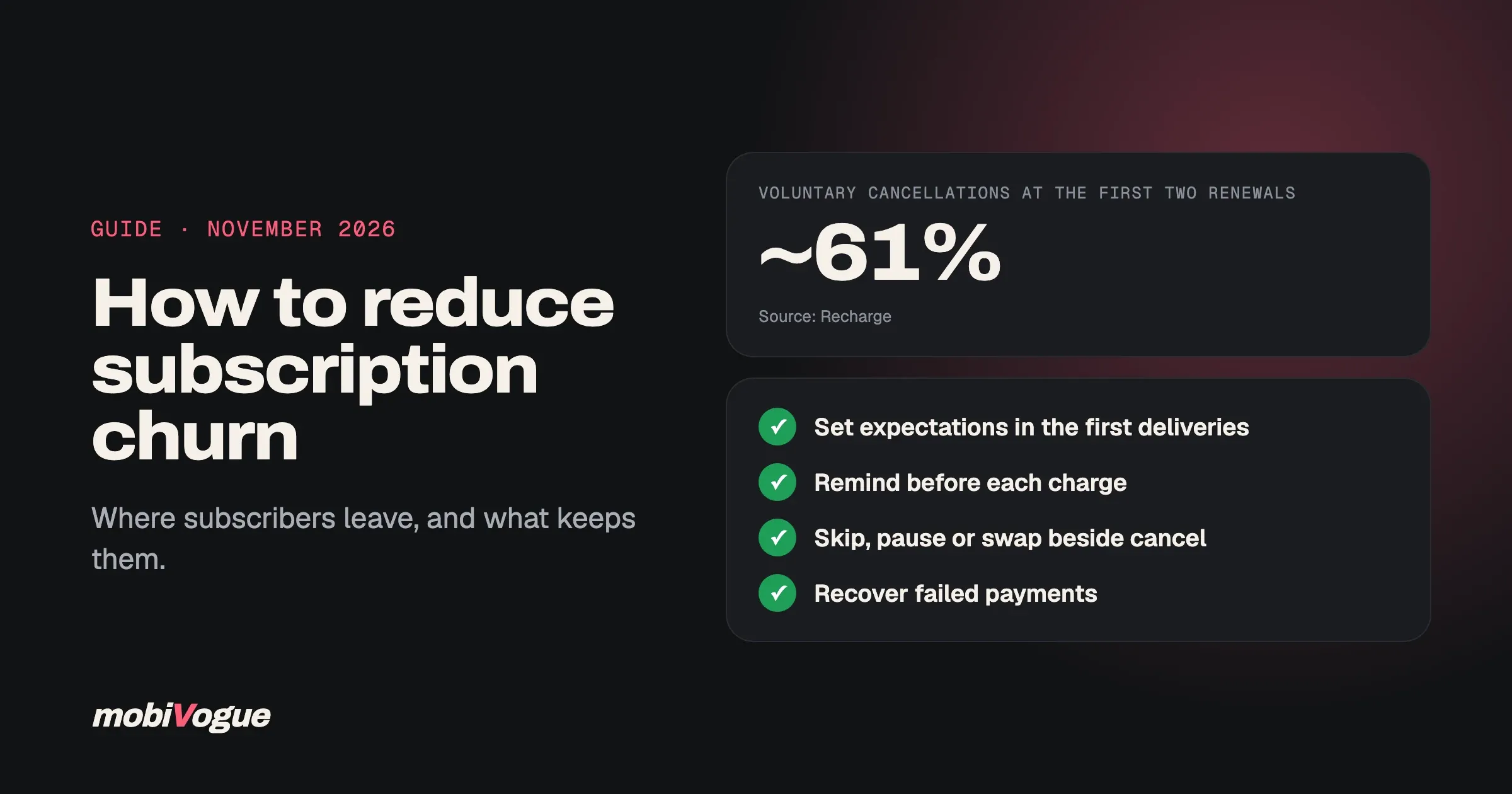
Most subscription churn happens early: Recharge found about 61% of voluntary cancellations come at the first two renewals. Cut it in that order. Set expectations in the first deliveries, remind subscribers before each charge, offer skip, pause, swap or a new frequency beside the cancel button, and recover failed payments with retries and card updates.
The churn checklist
Ten levers, in the order we’d pull them. The first six act on voluntary churn, when a subscriber chooses to leave. Three act on involuntary churn, when a payment fails and is never recovered. The last one tells you which is working.
| Lever | Churn it fixes | What to do | Evidence | Who runs it |
|---|---|---|---|---|
| 1. Onboarding | Voluntary, early | Usage instructions, how long the pack lasts, a check-in before the first renewal | About 61% of voluntary cancels come at the first two renewals (Recharge, vendor data) | Email and SMS flows, app |
| 2. Reminder before each charge | Voluntary, and some involuntary (expiring cards) | 3 days ahead, with a one-tap skip | 3 days is the default in Shopify Subscriptions, Loop and Skio; no independent lift data | Subscription app, SMS, app push |
| 3. Flexible frequency | Voluntary | Offer intervals that match how long the product lasts | “Too much product” is 16% of cancel reasons (Chargebee, via Loop) | Subscription app |
| 4. Skip and pause | Voluntary | Offer them in the reminder and at cancel | 59% of supplement skips were followed by another order; under 2% of cancellers reordered (Recharge, vendor data) | Subscription app, portal, SMS, app |
| 5. Swap | Voluntary (product fatigue) | Flavor, size or product swap | 66% of supplement subscribers who took a swap offer reordered (Recharge, vendor data) | Subscription app |
| 6. Cancel flow matched to the reason | Voluntary | Cheapest offer first, discount last, cancel button always visible | Vendors claim 15–33% saved; Skio says most brands save under 5% | Subscription app |
| 7. Smart retries | Involuntary | Retry over about 2 weeks | 90% of recoveries happen within 10 days of the failure (Recurly, vendor data) | Subscription app |
| 8. Card updater and backup card | Involuntary | Turn on network card updates; collect a backup method | Stripe documents automatic card updates in the US | Payment processor, subscription app |
| 9. Fast card-update path | Involuntary | A failed-payment message that opens the card page directly | No lift data; we don’t claim one | Subscription app emails and SMS, app push |
| 10. Churn by renewal | Both | Track renewals 2 to 4 separately | Recharge’s own recommendation | Subscription app analytics |
Sources: Recharge, churn is front-loaded (July 2026, updated August 2026); Recharge, supplement retention (July 2026, updated October 2026); Loop (14 April 2026, citing Chargebee’s 2024 data, not Shopify-only); Recurly (30 April 2026); Stripe docs; save-rate claims from Recharge, Ordergroove and Skio. Default reminder timing linked in the reminders section below.
Measure churn by renewal first
Monthly churn is subscribers lost during the month divided by subscribers active on day 1. Leave out people who joined during the month. Annual churn isn’t 12 times monthly churn: it’s 1 − (1 − monthly churn)12, so 8% a month is about 63% a year, not 96%. The subscription churn calculator does the sums.
Then split it. Voluntary churn and involuntary churn have different fixes, and a skip button does nothing for a declined card. On Recurly’s ecommerce data, involuntary churn is about a third of the total: 1.38% against 2.87% voluntary. Use that split, not the level, which Recurly labels as annual.
Last, read churn by renewal. Recharge’s data shows a cliff, not a slope. Among subscribers reaching each renewal, voluntary churn was 24.1% at cycle 2 (the first renewal), 27.1% at cycle 3 and 16.6% at cycle 4, falling to 10.1% at cycle 6 and 2.4% from cycle 13 on. About 61% of voluntary cancellations came at the first two renewals and about 72% within the first four. A brand that only watches one blended monthly number misses where the problem is.
Sources: Recurly churn benchmarks (July 2026 data, vendor; involuntary share is our arithmetic); Recharge, churn is front-loaded (renewals July 2025 to March 2026, subscriber cancellations only, failed payments excluded; vendor data).
How to reduce churn in the first 30 days
The first renewals decide most of it, so start before the second order ships. Recharge’s supplement data shows the drop: 75.2% of first-order subscribers placed a first reorder, but only 34.4% reached a third and 15.5% a sixth. Recharge’s own advice is to use the first deliveries to set expectations and build the habit. It also says plainly that its data shows where churn concentrates, not which onboarding tactic fixes it.
We found no independent study of onboarding tactics for Shopify consumables, so these are practical steps, not proven lifts:
- Say how to use it. Servings a day, when to take or feed it, and what to expect in the first weeks.
- Say how long it lasts. “This bottle lasts 30 days at 2 capsules a day” stops the “too much product” cancel before it starts.
- Match the first interval to the pack. If a bag lasts 40 days, a 30-day default builds up stock. Work it out with the reorder timing calculator.
- Check in before the first renewal. A short message before cycle 2 that offers a skip or a new date, not a discount.
Source: Recharge, supplement retention vs other verticals (July 2026, updated October 2026; about 1,750 supplement brands, cohorts July 2025 to June 2026; vendor data); Recharge, churn is front-loaded.
Remind subscribers before each charge
A reminder moves the decision to before the charge, when a skip is still possible. Three days ahead is the common default: Shopify Subscriptions emails customers 3 days before each recurring charge, Loop’s upcoming-order email defaults to 3 days, and Skio’s SMS billing reminder defaults to 3 days once you turn texts on.
Use every channel a subscriber has chosen:
- Email reaches everyone. Your subscription app sends it.
- SMS reaches subscribers who opted in to texts, and some subscription apps let them reply to skip.
- App push reaches subscribers who installed your app and allowed notifications.
Put the skip in the message itself. Loop’s quick actions, for example, add one-click skip or delay links to Klaviyo, Attentive, Recart or Omnisend messages. Expect some cancellations to come earlier, before the charge rather than after it. That’s the trade: fewer unwanted charges, refunds and angry support tickets.
A reminder isn’t always a legal renewal notice. New York’s law requires one before renewal only for terms of a year or more, and other states set their own rules. Keep your subscription app’s notice emails on.
Sources: Shopify Help Center; Loop help, email notifications and skip quick action; Skio help, SMS notifications (5 February 2026); New York GBL 527-a (revised 7 November 2025). All read 23 November 2026.
Skip, pause, swap and frequency
Match the offer to the reason. In Chargebee’s 2024 data, quoted by Loop, the top cancel reasons were “too expensive” (31%), “I have too much product” (16%), “I want something different” (15%) and “I don’t need it anymore” (15%). That data covers all subscription types, not only Shopify brands. Skio’s best-practice guide maps reasons to offers:
- Too much product: a frequency change or a skip.
- Want something different: a swap to another flavor, size or product.
- Taking a break: a pause with a restart date.
- Too expensive: a discount, but last, and tied to how many orders they’ve had.
A save is worth something, but less than a subscriber who never wanted to leave. In Recharge’s supplement data, 59% of skips were followed by another order, against 78% after a charged order. Of subscribers who cancelled at the cancel screen, under 2% ordered again. Of those who accepted an offer there, 44% reordered after a skip, 49% after a discount, 53% after a delay and 66% after a swap. Different people pick different offers, so that doesn’t rank them.
Pause works the same way. Recurly found pause use rose 337% where “pause before cancel” was offered, and 3 in 4 people who paused came back within months, across all subscription types.
Treat a skip as a warning as well as a save. If your skip rate stays high, the interval is probably wrong for how long the product lasts.
Sources: Loop (14 April 2026, citing Chargebee); Skio help, cancel flow best practices (3 December 2025); Recharge, supplement retention (skips July 2025 to March 2026, tracked to September 2026; vendor data); Recurly, 76 million subscribers (14 January 2026; vendor data).
A cancel flow that’s honest and legal
A good cancel flow offers the cheapest alternative first, a skip or a new date, then a swap or pause, and a discount last. It asks for a reason in one optional question. And the cancel button sits on the same screen and works at once. Show alternatives beside cancel, never in front of it.
How many cancellations can you save? Every published figure is a vendor’s own claim, without a stated method. Recharge says “up to 33%”; Ordergroove says early adopters save 17–24% of subscribers who start to cancel; Skio says a well-configured flow saves 15–30%, and also that most brands save under 5%. Treat the spread as the honest answer.
| Rule | Status in November 2026 | What it means for a cancel flow |
|---|---|---|
| FTC click-to-cancel | 2024 rule vacated in July 2025; new rule at the comment stage, none proposed | Nothing new in force federally; the FTC still enforces existing law against hard-to-cancel plans |
| California | In force since 1 July 2025 | Cancel through the same channel used to sign up; save offers only with a direct cancel button shown at the same time |
| New York State | Revised 7 November 2025 | Cancelling must be as easy as signing up; offers can’t delay it |
| New York City | In effect 1 October 2026 | Cancellation as simple as enrollment, through the same avenues |
| Massachusetts | Enforced since 2 September 2025 | Cancel at least as easily as sign-up, through the same website or app |
| UK | Expected January 2027 | Renewal reminders and an easy exit |
Sources: Federal Register (March 2026); Jones Day (May 2026); Venable on California; New York GBL 527-a; Skadden on New York City (September 2026); Frankfurt Kurnit on Massachusetts; DWF on the UK (October 2026). Save-rate claims: Recharge, Ordergroove (20 August 2025), Skio; vendor claims. This isn’t legal advice; check with your lawyer.
Fix involuntary churn
Involuntary churn needs payment fixes, not offers. Recharge says that on average 7% of recurring charges fail on the first attempt, without citing a study. A failed charge only becomes churn when dunning, the retries and reminders that follow, runs out. Three things help:
- Smart retries. Stripe’s default is up to 8 retries within 2 weeks. Skio suggests starting with 7 retries, 3 days apart, and its Smart Retries adjust the timing. Recurly reports that 90% of recovered payments are recovered within 10 days of the failure, so the first days matter most.
- Card updates and a backup card. Stripe automatically tries to update saved cards when a customer gets a new one, and says this is widely supported in the US for Amex, Visa, Mastercard and Discover; international support varies. Loop can fall back to a backup payment method. Ask your subscription app and payment processor whether automatic card updates are on for your store.
- A fast path to the card page. Send the failed-payment message at once, with a link that opens the card form directly, not the portal’s home page.
All three live in your subscription app and payment processor. Turn them on there first.
Sources: Recharge, failed payment recovery (vendor claim); Stripe Smart Retries; Skio help, payment recovery (17 August 2026); Recurly (30 April 2026, vendor data); Stripe, how cards work; Loop help, recovery via retries.
Where an app helps, and where it doesn’t
An app helps where the subscriber already looks: the phone’s lock screen and home screen. In an app built with MobiVogue, a push goes out 3 days before each charge by default (you can set 1 to 7) and opens the subscription screen with “Skip next order”. Recharge, Loop, Recurpay and Seal subscribers skip, pause, swap or change frequency on the app’s own screens; other subscription apps open their own portal inside the app. When a payment fails, a push opens the subscription app’s own secure card page, for apps that report failed charges. Cancel is two taps from the subscription screen, with skip, pause or “less often” next to an equally clear cancel button.
An app doesn’t help with:
- Subscribers who never install it. Eightx estimates only 5–15% of repeat customers install a brand’s app. Everyone else keeps using email, SMS and the portal.
- A declined card. Retries and card updaters run in the subscription app and processor.
- Your subscription app’s own retention offers. The in-app cancel screen is MobiVogue’s, not your subscription app’s flow.
No independent study yet shows in-app management lowering churn compared with a web portal, and we have no churn data of our own to publish. For the fair comparison, read mobile app vs subscription portal. For the product details, see in-app subscriptions and apps for subscription brands; for message wording, our push notification templates.
Source: Eightx (24 May 2026, advisory estimate).
What we’d do
Our recommendation
If we ran a supplement or pet food subscription on Shopify, we’d look at churn by renewal cycle first, because that’s where most of it is. Then we’d turn on, in this order:
- A reminder three days before every charge, with a one-tap skip.
- Frequency choices that match how long the product lasts.
- A cancel flow that offers a skip or a new date first, a swap second and a discount last, with the cancel button on the same screen.
- Smart retries, card updates and a backup payment method in the subscription app.
Only then would we add channels: text-to-manage if most subscribers have opted in to SMS, and an app if subscribers buy often enough to keep it. The payback calculator tells you whether they do. Re-check churn at renewals 2 and 3 after one full cycle.