Guide
Is a mobile app worth it for your Shopify store?
 By Dr. Nisarg Patel, MobiVogue Updated
The short answer
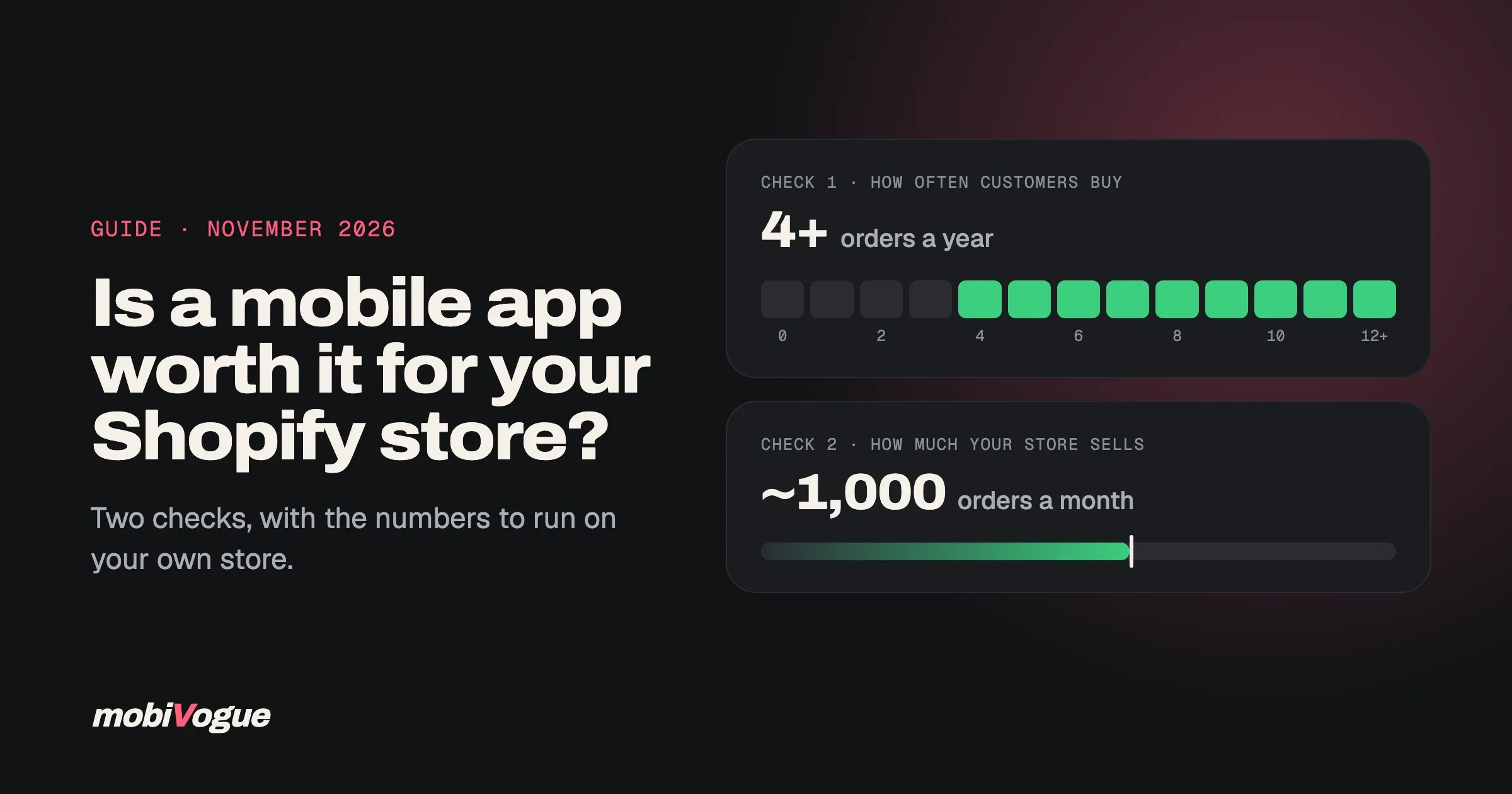
An app usually pays back when your customers buy four or more times a year, which for most stores means a subscription or a product that runs out, and you have about 1,000 orders a month. Subscriptions and refill reminders are what get a store over that line, and the payback calculator shows where yours stands today.
Check your own numbers in the payback calculator. The four-orders bar comes from an advisory firm’s review of app payback. The 1,000 orders a month is our rule of thumb from the calculator’s math, not a study. Both are explained below. Numbers checked November 2026.
A quick check in eight questions
Answer yes or no. The first and third questions matter most.
| # | Question | Why it matters |
|---|---|---|
| 1 | Do repeat customers reorder about every three months or sooner? | Four or more orders a year is the bar every source agrees on, and the calculator’s first test. |
| 2 | Do you sell something that runs out, or run subscriptions? | Subscribers order far more often than one-off buyers in the same category. |
| 3 | Do you have about 1,000 orders a month or more? | Below that, the lift the app needs from app customers climbs fast. |
| 4 | Do a quarter to a third of your customers buy again? | Shopify says most stores show a returning-customer rate of 20–40%. Installs come only from repeat customers. |
| 5 | Is your average order above about $30, with a healthy margin? | Each extra order covers less of the cost when order value is low. |
| 6 | Do you send SMS reminders that push could replace? | A text costs about 1.2 cents with carrier fees. Push has no carrier fee. |
| 7 | Is there a reason to open the app between orders? | Refill reminders, subscription changes and loyalty give people a reason. Frequent use is the top reason shoppers keep a brand app. |
| 8 | Are your mobile site and email flows already in good shape? | An app works alongside them: it keeps existing customers ordering, while your site and email reach everyone else. |
How to read it: if 1 and 3 are yes, run the calculator: an app is likely worth it. If 1 is no, start with subscriptions or refill reminders on your site, then check again. If only 3 is no, run the numbers again as you get closer to 1,000 orders a month.
Sources: Eightx, 24 May 2026 (advisory firm), Eightx purchase frequency, 27 June 2026, Shopify Help Center, analytics fields, Postscript pricing, November 2026 (vendor price), Adobe survey of 1,000 US shoppers, August 2026 (via PPC Land). The order and order-value lines are our reading of the payback calculator.
Condition 1: customers buy four or more times a year
Eightx, a CFO advisory firm that works with Shopify brands, says “Apps only pay back when customers buy 4 or more times per year.” It’s an adviser’s judgment, not a published study, and it’s the bar our calculator uses. It also fits how shoppers behave: people keep apps they open often and delete the rest.
Typical buying cycles by category look like this. Treat them as estimates; your own data is better.
| Category | Typical days between orders | Orders a year, no subscription | Orders a year, subscription or loyalty | Clears the bar? |
|---|---|---|---|---|
| Supplements | 30 | 2–4 | 7–10 | Yes, with subscriptions or refill reminders |
| Pet food | 30 | 3–5 | 8–12 | Usually |
| Food, drink and coffee | 45 | 2–4 | 6–9 | With subscriptions |
| Beauty | 75 | 2–4 | 4–7 | Often, with a routine |
| Apparel | 120 | 2–3 | 3–4 | Rarely |
| Home | 270 | 1–2 | 2–3 | No |
Sources: Eightx, average time between orders by vertical (medians; some estimated from nearby categories) and Eightx, purchase frequency by vertical, 27 June 2026. Advisory firm estimates, not audited data.
The pattern is the point. One-off buyers of consumables sit at or just below four orders a year. Subscribers sit well above it. That’s why subscriptions and refill reminders matter: they are what move a consumable brand over the line. A subscription doesn’t replace order volume; it gets your customers to the frequency where volume starts to count.
To check your own store, open Shopify Analytics and look at your returning-customer rate (Shopify says most stores show 20–40%) and the typical days between a customer’s orders. If that gap is longer than about 91 days, subscriptions or refill reminders are the first step to closing it. See reorder interval and repeat purchase rate.
Source: Shopify Help Center, analytics fields.
Condition 2: enough orders for installs to add up
Only some of your repeat customers will install. Eightx puts it at 5% to 15%. The app’s cost has to be covered by extra orders from that small group, so the number of orders behind it matters. Our calculator works it out like this:
- App customers = repeat customers × the install rate.
- Orders moving to the app = what those customers already buy. These orders move; they aren’t added.
- Extra orders needed = the app’s monthly cost, including Apple’s $99 a year, ÷ the margin on one order.
- Lift needed = extra orders needed ÷ orders moving to the app. Up to 10% is likely to pay back; up to 25% could.
At the calculator’s defaults (35% of customers buying again, a $40 order, a 60% margin, a 10% install rate and no SMS), a store with 1,000 orders a month moves about 35 orders a month into the app and needs about 5 more to cover the cost. That’s a 14% lift: possible, if reminders do their job.
| Orders a month | Orders moving to the app | Lift needed | At 15% to 5% installs | Verdict |
|---|---|---|---|---|
| 250 | 9 | 57% | 38% to 114% | Not yet |
| 500 | 18 | 29% | 19% to 57% | Not yet |
| 1,000 | 35 | 14% | 10% to 29% | Could pay back |
| 1,500 | 53 | 10% | 6% to 19% | Likely pays back |
| 2,500 | 88 | 10% | 7% to 21% | Could pay back |
Method: our payback calculator at its default inputs, using the cheapest plan that fits each volume. Above 1,500 orders a month it moves to a higher-priced plan, so the lift needed doesn’t fall in a smooth line. Install rate: Eightx, May 2026.
So “about 1,000” is a round number, not a cliff. At these defaults a store first reaches “could pay back” at about 580 orders a month. If you want subscribers to manage their subscription in the app, the calculator uses a higher-priced plan and the line moves up to about 1,030. A higher order value, a better margin or more installs bring it down; a $30 order or a 5% install rate push it up.
Two things this model doesn’t do. How often customers buy is a gate, not a multiplier: once they clear four orders a year, the reorder gap cancels out of the lift. And SMS savings count only if you text today: if app customers who allow push get reminders by push instead, the texts you stop sending pay part of the cost.
What an app changes
Here is what the published figures say, and how to read each one. None is an independent study of Shopify brands, so treat them as a guide and measure your own app after launch.
- Revenue after launch. Tapcart, an app builder, reports an average total revenue lift of 21.13% after brands launched an app, but only 9.82% in health and wellness and 16.36% in food and beverage. It’s the builder’s own observational data, with no control group.
- Conversion. Criteo found shopping apps converted more than three times better than mobile web in North America in 2018. Ampifyme, itself an app vendor, admits “Some of that ‘app lift’ is selection effect, not causation.” App users are already your best customers.
- Share of repeat revenue. Eightx says brands that meet its conditions see 20–40% of repeat revenue shift to the app. Shift means moved from your website, not added.
- Push. About half of app users allow push. Airship’s 2024 medians were 49.4% on iPhone and 59.5% on Android.
Plan on moving orders into the app and saving some SMS spend, then measure the extra orders it adds after launch.
Sources: Tapcart, 30 September 2025 (vendor data), Criteo, 10 May 2018, Ampifyme, 25 August 2026 (vendor), Eightx, May 2026, Airship 2025 push benchmarks (vendor data).
When to wait, and what to do first
- Customers buy once or twice a year. Apparel, home goods and gifts often sit here. Grow how often they buy first, with subscriptions, refill reminders or loyalty on your site, then check again.
- You have a few hundred orders a month. At 250–500 orders, the calculator needs a 29% to 57% lift from app customers. That falls as orders grow, so run it again each quarter.
- You want new customers. An app keeps the customers your ads, search and social bring in. Pair it with them rather than expecting installs from first-time visitors.
- You’d judge it on downloads. Judge it on repeat orders instead. In an Adobe survey of 1,000 US shoppers, 72% had installed a brand or retail app for one discount and then deleted it, so downloads alone say little.
- No one owns it yet. Push campaigns and in-app content need an owner. The developer accounts cost $99 a year at Apple and $25 once at Google.
- Your mobile site or email flows need work. Get them in shape alongside the app. They reach every customer, and the app reaches the ones who buy most.
Shoppers keep the apps of the stores they use most: Baymard found 75% of shoppers had the app for their most-used shopping site. One cost you won’t pay: Apple and Google take no commission on physical products sold in an app, which go through your own checkout.
Sources: Adobe survey, August 2026 (via PPC Land), Apple guideline 3.1.3(e), Google Play payments policy, Baymard, June 2021.
Where other people draw the line
Others publish a line too. None shows the data behind it.
| Source | Their line | Who they are |
|---|---|---|
| Eightx, May 2026 | Customers buying 4 or more times a year; no revenue line | Advisory firm |
| Tapday, April 2026 | “around 1,000 to 2,000 monthly orders”, an email list of 10,000 or more | App builder; no source given |
| Ampifyme, August 2026 | Around $500,000 a year in online revenue; skip under about $30,000–$50,000 a month | App vendor |
| attn | Poor fit under $500,000 a year in revenue | Marketing agency |
| Shopify Partner, July 2026 | Under about $250,000 a year, low-cost builders are usually enough | Forum reply |
| Our calculator | 4 or more orders a year, then a lift needed of 25% or less | Our own model, shown in full |
They cluster around $500,000 a year. At a $40 order, that’s about 1,000 orders a month (our arithmetic), which is roughly where our calculator lands too.
How to tell if it’s working after launch
Give it one reorder cycle: about 30 days for supplements and pet food, about 75 for beauty. Then compare how often your app customers order now with how often they ordered before they installed. Check app orders in Shopify’s sales-by-channel report, so you’re reading Shopify’s numbers, not only your app builder’s. Watch your push opt-in rate too: reminders only work for customers who allow them. MobiVogue’s app analytics show app orders, push-attributed orders and reorders, and reconcile with Shopify’s report.
Source for reorder cycles: Eightx, time between orders by vertical.
What we’d do
Our recommendation
If your customers reorder at least every three months and you’re near 1,000 orders a month: build the app around the reorder, not the storefront. Put the refill reminder, one-tap reorder and subscription changes on the home screen. Ask for push after the first in-app order, not on first open. Judge it after one reorder cycle.
If you run subscriptions but are well under 1,000 orders a month: start with your subscription portal and reminder emails, and run the numbers again as orders grow.
If customers buy once or twice a year: grow how often they buy first, with subscriptions, refill reminders or loyalty, then run the numbers again.
Next: what an app costs, in Shopify mobile app cost, and how to build one, in how to turn your Shopify store into a mobile app. Weighing push against texts? See push notifications vs SMS.