Guide
Push notifications vs SMS for Shopify stores: cost, reach and results
 By Dr. Nisarg Patel, MobiVogue Updated
The short answer
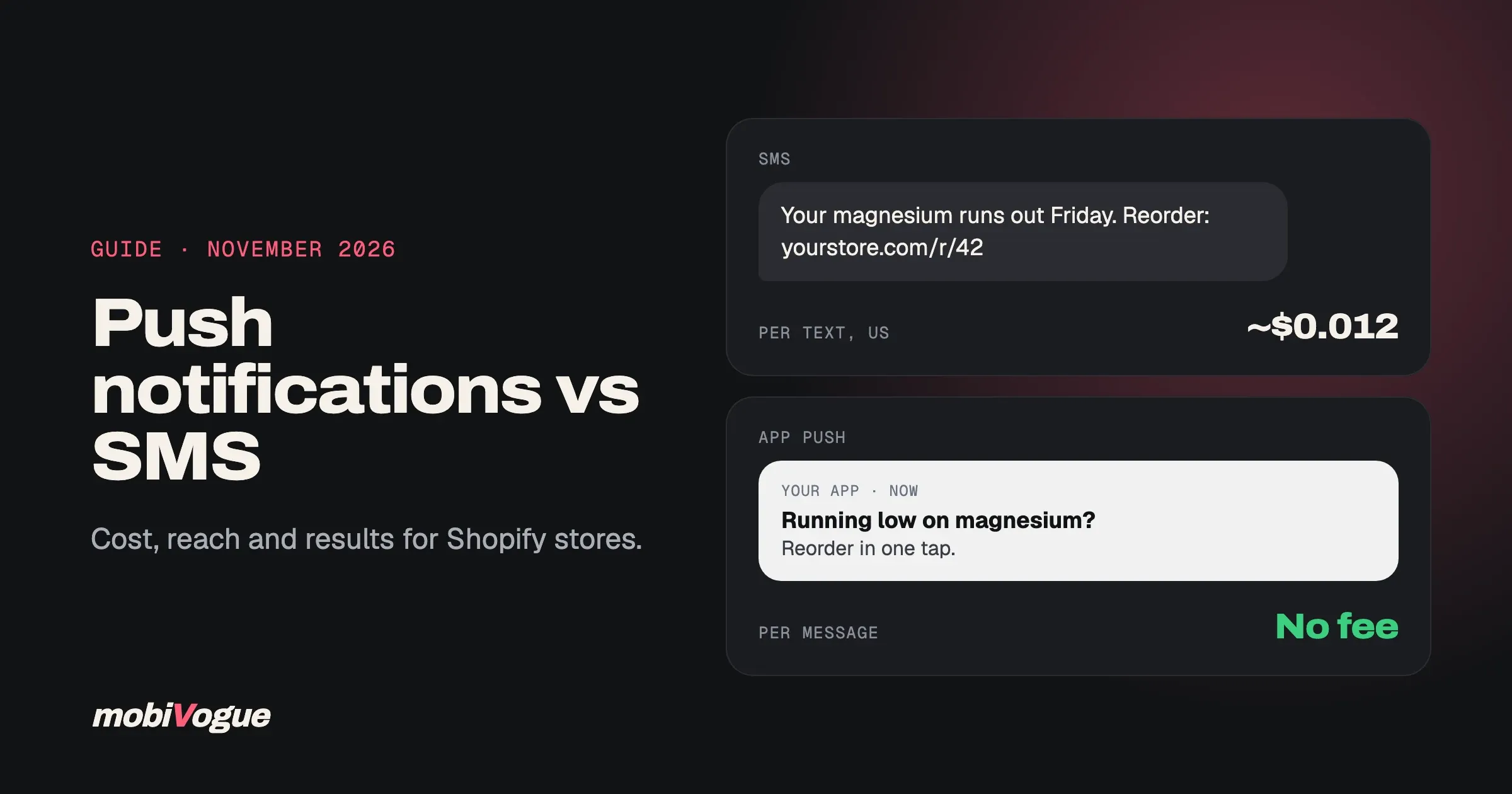
SMS costs per message: about $0.012 a text in the US and $0.06 in the UK on Shopify Messaging, more with an image. App push has no per-message fee, but it reaches only customers who installed your app and tapped Allow, roughly half of app users. Most repeat-purchase brands need both.
Push vs SMS at a glance
Texts get clicked more often; push costs nothing per send. That’s the trade in one line. The table puts the two side by side for a Shopify store, with prices read on 23 November 2026.
| App push | SMS | |
|---|---|---|
| Cost per message | None from Apple or Google | About $0.012–$0.01235 in the US; $0.06 in the UK on Shopify Messaging |
| Fixed costs | The app itself, plus Apple $99 a year and Google $25 once | Your SMS app’s plan or minimum, and sometimes a number fee |
| Who it reaches | App users who allowed notifications: about half | Anyone who gave a number and consent; no install needed |
| Consent | The phone’s permission prompt, plus Apple’s in-app consent rules for marketing | US: prior express written consent. UK: consent, or the soft opt-in for existing customers |
| Images | Included at no extra cost | An MMS costs about 3 times a text |
| Typical response | Median direct open about 3% of pushes sent | Median click rate 5.6% on campaigns, 9.65% on flows |
| Sending hours | Set by the app (MobiVogue: 9 pm to 8 am quiet hours by default) | Set by law: no marketing texts before 8 am or after 9 pm local time in the US, stricter in some states |
Sources: Shopify Messaging SMS pricing and Postscript pricing (read 23 November 2026); Firebase pricing; Airship 2026 benchmarks (2025 data) and Airship 2025 report (2024 data); Klaviyo SMS benchmarks; Klaviyo, US SMS compliance; ICO, electronic mail marketing. Response figures are vendor benchmarks with different definitions; compare them with care.
What SMS costs a Shopify store
You pay for every text. The price depends on the app you send with, the country, the length of the message and whether it has an image.
| Provider | US text | UK text | Fixed fees |
|---|---|---|---|
| Shopify Messaging | $0.012 | $0.06 | $2.15 a month per toll-free number (US and Canada) |
| Postscript Growth | $0.01235: $0.008 plus a $0.00435 average carrier fee | $0.25 (international rate) | $100 a month |
| Klaviyo | About $0.012–0.015, carrier fees included (third-party reading) | Not public | Free and Email plans include $5 of messages a month |
| Attentive | Not published | Not published | Custom |
Sources: Shopify Messaging, Postscript pricing and Postscript international rates (4 February 2026), Klaviyo pricing, all read 23 November 2026; Klaviyo per-text range from getkanal (calculator read 24 October 2026, third party). Attentive says it charges per message and by subscriber count.
What pushes the bill up:
- Length. A text holds 160 characters, or 70 if it contains an emoji. One character over and it’s billed as two.
- Images. An MMS on Postscript Growth costs $0.03832 with the average carrier fee, about 3 times a text.
- Country. A UK text costs 5 times a US text on Shopify Messaging. Postscript’s listed rates cover the US and Canada only.
- Replies and confirmations. Shopify bills double opt-in confirmations and keyword replies like any other message.
Klaviyo moved from SMS credits to dollar prices per message in July 2026, so older “credit” price lists are out of date. Under the old credits, a UK text cost 5 times a US text and an Australian text 4 times. If you send through Shopify Messaging, Klaviyo or Postscript, number registration is handled for you.
Sources: Klaviyo, SMS pricing change FAQ (updated 25 October 2026); Klaviyo, legacy SMS credits (updated 26 October 2026); Shopify Messaging.
What push costs
Sending a push costs nothing per message. Google lists Firebase Cloud Messaging as a no-cost product, and Apple publishes no per-push fee. Klaviyo includes unlimited push on every plan for apps connected to it.
The cost is the app. Every app in both stores needs an Apple Developer account at $99 a year and a Google Play account at $25 once, plus whatever the app builder charges. Some push and notification tools bill per subscriber or per monthly active user, so check. MobiVogue has no per-message, per-subscriber or per-active-user charge, and plans start at $99 a month.
Sources: Firebase pricing, read 23 November 2026; Apple Developer Program; Google Play Console Help.
So “push is free” isn’t quite right. “No per-message fee” is.
Who each channel reaches
SMS reaches anyone who gave you a number and agreed to texts. Push reaches a narrower group: people who installed your app and then tapped Allow.
- Installs: typically 5% to 15% of repeat customers install a brand’s app, says Eightx, an advisory firm.
- Opt-in: Airship’s median opt-in was 48.85% on iPhone and 53.3% on Android in 2025. Our calculator uses 50%.
Sources: Eightx (24 May 2026); Airship 2026 benchmarks (2025 data, vendor benchmark).
On the payback calculator’s default store (1,500 orders a month, 35% from returning customers, a 30-day reorder cycle), that’s about 518 repeat customers and about 26 people reachable by push. Push reaches a small, valuable slice. Email and SMS reach the rest.
Our arithmetic, using the calculator’s formulas and defaults.
What moving texts to push saves
Start with the headline comparison: 10,000 people getting 8 messages a month, or 80,000 messages.
| Channel | Message fees a month | Also |
|---|---|---|
| SMS, Postscript Growth (US) | $988 | plus $100 plan |
| SMS, Shopify Messaging (US) | $960 | plus $2.15 number |
| SMS, Shopify Messaging (UK) | $4,800 | |
| MMS with an image, Postscript Growth (US) | $3,066 | plus $100 plan |
| App push | $0 | the app plan is the cost |
Our arithmetic: messages × the per-message prices above, read 23 November 2026.
That table assumes all 10,000 people have your app. Here is the version for a real store: what a store saves when every customer who can get a push gets it instead of 4 texts a month.
| Orders a month | Repeat customers | Reachable by push | Saved a month, US | Saved a month, UK |
|---|---|---|---|---|
| 1,500 | 518 | 26 | $1.28 | $6.21 |
| 5,000 | 1,726 | 86 | $4.26 | $20.71 |
| 10,000 | 3,452 | 173 | $8.53 | $41.42 |
| 20,000 | 6,904 | 345 | $17.05 | $82.85 |
Our arithmetic, with the payback calculator’s formulas: 35% of orders from returning customers, a 30-day reorder cycle, 10% install (Eightx), 50% opt-in (Airship), $0.01235 a text in the US (Postscript Growth) and $0.06 in the UK (Shopify Messaging).
For SMS savings alone to cover an app at $99 a month plus Apple’s fee, you’d need about 2,171 customers with push turned on in the US, or about 447 in the UK. Few stores have that many. SMS savings rarely pay for an app on their own; repeat orders have to.
The real case for push is different. Because each push costs nothing, you can send reminders you’d never pay to text: “running low” a few days before a customer runs out, back in stock, a subscription charge coming up. That case is stronger in the UK and other countries where texts cost more. Put your own SMS list into the payback calculator under “Do you send SMS?” to see your number.
What the benchmarks say
On published vendor data, a text gets clicked more often than a push gets tapped. Push wins on cost per send, not on response per message.
| Measure | Figure | What it counts |
|---|---|---|
| SMS click rate | Campaigns 5.6%, flows 9.65% | Klaviyo customers, 183,000+ |
| SMS order rate | Campaigns 0.27%, flows 1.9% | Klaviyo, ecommerce |
| SMS revenue per text | Median about $0.98 | Attributed revenue ÷ texts sent; 17,000+ Shopify stores on Postscript, 2025 |
| Texts per subscriber | Median about 1.91 a month | Postscript, 2025 |
| Push direct open rate | iPhone 3.1%, Android 3.4% | Taps that open the app ÷ pushes sent; Airship, 2024 data |
| Push click rate, ecommerce | iPhone 3.05%, Android 3.78% | Opens ÷ recipients; 600+ apps on Pushwoosh, late 2024 to mid 2025 |
| Triggered vs broadcast | SMS back in stock: 36–58% click. Contextual push: 14.4% open vs 4.19% generic | Postscript, 2025; Batch, mid 2024 to mid 2025 |
Sources: Klaviyo SMS benchmarks (read 23 November 2026); Postscript benchmarks (8 January 2026); Airship 2025 report; Pushwoosh (14 August 2025); Batch. Vendor benchmarks, each measured on its own customers and definitions. Compare within a row, not across rows.
Two lessons hold in both channels. Messages triggered by something the customer did beat broadcasts by a wide margin. And no current benchmark publishes a “98% SMS open rate”, so treat that figure as folklore.
Consent and sending rules
A summary, not legal advice. Check the details with your SMS provider or a lawyer.
US texts
- Consent: marketing texts need prior express written consent. Private lawsuits can claim $500 per violation, up to 3 times that for knowing or wilful ones.
- Opt-outs: from 25 November 2026, according to law firms’ summaries of the FCC’s revised rule, opt-outs must be honoured within 10 business days, and a reply of stop, quit, end, cancel, unsubscribe, revoke or opt-out must work. We haven’t confirmed that date in the Federal Register itself.
- One-to-one consent: the FCC’s 2023 rule never took effect. A federal appeals court struck it down in January 2025, as law firms reported.
- Hours: no marketing texts before 8 am or after 9 pm in the recipient’s time zone. Some states are stricter; Klaviyo notes that even a 9 am to 8 pm window doesn’t meet every state’s rules.
Sources: Klaviyo, US SMS compliance (updated 27 October 2026); law-firm summaries from Troutman (17 September 2026) and Brownstein (27 October 2026); Klaviyo, SMS settings.
UK texts
Under PECR, you need specific consent to send marketing texts. The exception is the soft opt-in: existing customers who bought something similar and were given a simple way to opt out when you collected their number and in every message since.
Source: ICO, electronic mail marketing, read 23 November 2026. The ICO says this guidance is under review.
Push
Push isn’t covered by SMS law, but it isn’t rule-free. Apple’s guideline 4.5.4 says marketing push needs explicit opt-in through consent language in the app, and a way to opt out in the app. Android 13 and later starts every new app with notifications off until the customer agrees. Klaviyo says a push token alone doesn’t establish consent to marketing push.
MobiVogue builds these in: no permission prompt on first launch, a cap of one marketing push a day and three a week by default, quiet hours from 9 pm to 8 am in the customer’s time zone, and a separate in-app switch for each kind of push.
Sources: Apple App Review Guidelines 4.5.4; Android Developers, notification permission; Klaviyo, push in flows, all read 23 November 2026.
Using both in one Klaviyo flow
Most stores already send email and SMS from Klaviyo. The goal is simple: app users get the push, everyone else gets email or a text, and nobody gets the same reminder twice.
- An event starts the flow: a refill due, an abandoned cart, a product back in stock.
- A split checks whether the customer can receive app push.
- Yes: the app sends the push. No: the flow sends email or SMS.
Klaviyo’s own guidance is to make email the default message, check push and SMS consent with separate splits, and
not send a push at the same moment as another message. With MobiVogue, the app sends the push and tells Klaviyo who
has the app and who allowed push, through the has_app and app_push_enabled profile
properties. You split your flows on app_push_enabled. MobiVogue never sends SMS or WhatsApp; your SMS
app keeps doing that.
Source: Klaviyo, add push to an abandoned cart flow (updated 26 October 2026).
See push notifications for how MobiVogue’s push works, and the push notification templates for messages to start from.
What we’d do
Our recommendation
- Keep email and SMS for everyone. They reach the customers who will never install an app, which is most of them.
- If customers reorder four or more times a year, move reorder, refill and back-in-stock reminders to push for app users, and split Klaviyo flows so nobody gets both.
- Keep SMS for moments worth paying for: launches, time-limited offers, and customers without the app. If you want a fallback, text only after a push has gone unopened for a day.
- Keep texts short and plain. Stay under 160 characters, skip the emoji, and send an image only when it earns about 3 times the price.
- Judge on orders, not opens. After one reorder cycle, compare orders per 1,000 customers reached in each channel.
- Sell in the UK or other high-cost countries? Each customer moved to push saves more, so the case for push is stronger.
Before you buy an app for push, check if an app pays back with your own SMS list. Our guide to mobile app vs mobile website covers the wider choice.