Guide
Mobile app vs mobile website: what each does for a Shopify store
 By Dr. Nisarg Patel, MobiVogue Updated
The short answer
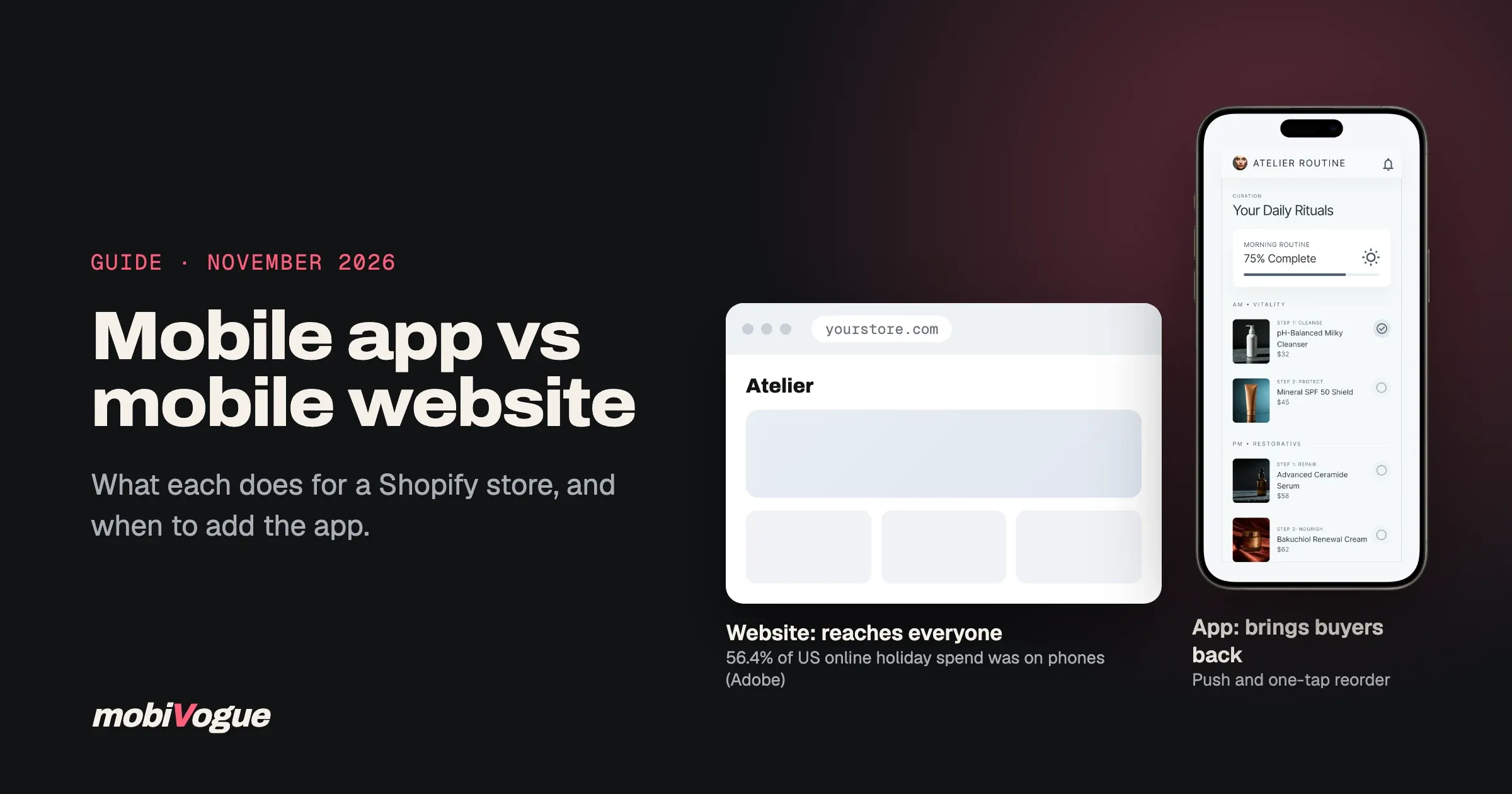
A mobile website reaches everyone; an app reaches your repeat buyers with push and one-tap reorder. Every Shopify store needs a fast mobile site first: smartphones made 56.4% of US online holiday spending in 2025 (Adobe). Add an app when customers buy four or more times a year, because typically only 5–15% of repeat buyers install one (Eightx).
At a glance
This isn’t a contest with one winner. The mobile website is your reach channel: everyone who finds you through search, ads, social and email lands there. An app is a smaller, higher-intent channel for the customers who already buy again. The website wins several rows below.
| Mobile website | Mobile app | |
|---|---|---|
| Who it reaches | Every visitor, new and returning | Only people who install it: typically 5%–15% of repeat customers |
| How people find it | Google search, ads, social, email links | The App Store and Google Play, or a link or QR code from your site and emails |
| Cost | Included with Shopify and your theme | About $79 to $3,500 a month for a native builder, plus Apple $99 a year and Google $25 once |
| Conversion | About 2% on phones vs 3.4% on desktop | No independent current benchmark |
| Push notifications | Web push on Android; on iPhone only after a Home Screen install. 2.7% average opt-in on Shopify Plus stores (2022) | On iPhone and Android. Median opt-in 49.4% on iPhone, 59.5% on Android (2024 data) |
| Reorder | Shop Pay and customer accounts; shoppers sign in again on each device or browser | Stays signed in; one-tap reorder and a buy-again shelf are possible |
| Search | Ranks in Google; Core Web Vitals matter | Doesn’t appear in Google web results |
| Updates | Instant | Content changes can be instant; new features need store review |
| Drop-off | Nothing to uninstall | 46.1% of installed Android apps are uninstalled within 30 days (all categories, 2024) |
Sources: installs from Eightx (24 May 2026, advisory); builder prices from each vendor’s pricing page, checked 23 Nov 2026; conversion from Contentsquare (updated 25 August 2026); push opt-in from Airship’s 2025 report (2024 data) and PushOwl (5 July 2022), different bases, vendor data; uninstalls from AppsFlyer’s 2025 uninstall report; search from Google Search Central.
Mobile statistics for 2026
Phones are now where most online shopping happens. None of the figures below splits app sales from browser sales, so none of them tells you how much shopping happens in apps.
- 56.4% of US online holiday spending (1 November to 31 December 2025) happened on smartphones, up from 54.5% in 2024. Adobe Analytics, 1 trillion+ visits to US retail sites.
- 70% of online orders during Cyber Week 2025 (25 November to 1 December) came from mobile devices, worldwide and in the US. Salesforce, 1.5 billion+ shoppers.
- 69.9% of site traffic was mobile in Contentsquare’s 2026 benchmark of 99 billion web and app sessions.
- About 2% conversion on mobile web against 3.4% on desktop. Contentsquare, 2026.
- 3.6 hours a day spent in apps in 2025, across all categories. Retail app downloads and time spent fell in 2025. Sensor Tower.
- 15% more shopping app sessions worldwide in the first half of 2026 than a year earlier. Adjust, via a press release.
- 46.1% of installed Android apps were uninstalled within 30 days in 2024, all categories. AppsFlyer.
Sources, all vendor benchmarks: Adobe (7 January 2026); Salesforce (5 December 2025); Contentsquare benchmark (9 March 2026); Contentsquare mobile stats (updated 25 August 2026); Sensor Tower, State of Mobile 2026; Adjust via Investing News (26 August 2026); AppsFlyer (2025 edition).
Adobe and Salesforce measure different things. Adobe counts smartphones and spending over the whole US season; Salesforce counts all mobile devices and orders over one week worldwide. Don’t add them up or average them.
Do apps convert better than mobile websites?
Probably, for the people who use them. But nobody has published an independent, current figure for Shopify stores, and the reason matters. The customers who install your app are your most loyal ones. They would convert well anywhere. When an app builder says its apps convert several times better than mobile web, it’s comparing those loyal customers with every visitor to your site, including first-timers.
The best independent evidence is one academic study. At a large retailer that launched an app, customers who adopted it bought 33% more often, bought 34% more items and spent 37% more than similar customers who didn’t. They also returned more. That’s one retailer, measured before 2019. An older figure from Criteo, 18% conversion in apps against 4% on mobile web for retailers with both, comes from 2017-era data with no sample size given.
Sources: Narang and Shankar, Marketing Science 38(5) (2019, peer-reviewed); Criteo (first published 21 November 2017, vendor benchmark).
The fair way to know is to test on your own customers. Hold back part of your app users from a reminder and compare their orders with the rest after one reorder cycle. Then check app orders in Shopify’s sales-by-channel report, not only in the app vendor’s dashboard.
Why your mobile site comes first
Your site is where new customers arrive, where ads and search send people, and where anyone without your app buys. Google says it “highly recommend[s]” good Core Web Vitals for success in search, and its thresholds are LCP within 2.5 seconds, INP under 200 milliseconds and CLS under 0.1. Apps you install on the store can slow it down: Shopify’s Built for Shopify badge requires that an app cut storefront speed by no more than 10 performance points.
There’s room to improve on both sides. Baymard rates 75% of mobile ecommerce sites as only “mediocre” for user experience. Apps aren’t automatically better: 71% of 30 leading ecommerce apps scored “mediocre” or worse.
Sources: Google Search Central, Core Web Vitals; Shopify Help Center; Baymard on mobile sites (updated 14 July 2026) and apps (updated 14 April 2026), third-party research.
Before you spend on an app, make sure the site does these well:
- Core Web Vitals in the green on phones, with apps you don’t use removed
- Shop Pay turned on, so returning shoppers check out fast
- Customer accounts on, so past orders are one sign-in away
- Reorder links in your post-purchase emails and texts
What an app adds for repeat buyers
An app earns its place with customers who buy the same things again. It stays signed in, so their last order is one tap away. It can send a push at the moment they’re running low, with no per-message fee. And subscribers can skip or pause from their home screen instead of finding a portal link in an old email.
Be realistic about reach. Take 10,000 repeat customers. If 10% install the app, that’s 1,000 app users. If about half allow notifications, about 500 people can get a push. Everyone else still needs your website, email and SMS.
Our arithmetic, using the install share from Eightx and opt-in medians from Airship (2024 data), the same defaults as our payback calculator.
That small group can still matter a lot when they order every month. It’s why apps suit supplements, skincare, pet food and coffee and tea more than one-off purchases. See push notifications and one-tap reorder for how MobiVogue handles both, and push notifications vs SMS for what each costs.
What about a PWA on iPhone?
A progressive web app is your website with an install option. On Android it’s straightforward. On iPhone, which made up about 52% of US phones in October 2026, the details decide whether it works for reminders.
- Push needs a Home Screen install. Since iOS 16.4, a web app added to the Home Screen can ask for push permission, and only after the shopper taps something. Push doesn’t work in Safari itself.
- iOS 26 changed the default, not the step. Every site added to the Home Screen now opens as a web app. The shopper still has to add it from the Share menu; there’s no install prompt like Android’s.
- Simpler push code since iOS 18.4. Declarative Web Push no longer needs a service worker, but it’s still for Home Screen web apps only.
- The EU still has them. Apple planned to remove Home Screen web apps in the EU with iOS 17.4, then reversed that on 1 March 2024. We found no later change.
Sources: WebKit on iOS 16.4 web push (16 February 2023), WWDC25 (9 June 2025) and Safari 18.4; MacRumors (1 March 2024); StatCounter, US mobile OS share (October 2026).
Shopify’s own comparison says there’s no universal winner and that stores can use both. A PWA is a cheap way to test whether shoppers will install anything. If push reminders are why you want an app, native does that job on every iPhone that allows it. The convert guide compares native, webview and PWA, and the glossary explains native app vs PWA.
Source: Shopify blog, progressive web app vs native app (27 July 2026).
When to start with the site
Put the mobile site first, and add the app when these change:
- How often customers buy. Eightx says apps pay back “when customers buy 4 or more times per year”. Subscriptions and refill reminders are how stores get there.
- The size of your repeat base. A 5–15% install share works best on a repeat base in the thousands, not dozens.
- What you sell. Gifts and occasion buys rely on the site; products customers reorder are where an app earns its place.
- Your mobile site. Make it fast and simple first: it serves the 85% or more of customers who never install an app.
An app builder’s employee in a 2026 Shopify Community thread put it well: an app works best as a retention tool for the customers you already have.
Sources: Eightx (24 May 2026); Shopify Community thread (30 June to 17 November 2026). The 85% follows from the 5–15% install share.
The payback calculator uses the four-a-year line and will say “not yet” when that’s the answer, and what would change it. Our guide is a mobile app worth it? goes deeper on payback.
What we’d do
Our recommendation
Every store: make the mobile site fast and simple first. Get Core Web Vitals in the green, turn on Shop Pay and customer accounts, and put reorder links in post-purchase emails. It reaches every shopper and costs nothing extra.
If customers buy four or more times a year, or you run subscriptions: add an app for the repeat base, and judge it on repeat orders and the app’s share in Shopify’s sales-by-channel report, not on vendor conversion multiples. MobiVogue is built for this case: refill reminders timed to pack size, one-tap reorder, subscription skip, swap and pause in the app for Recharge, Loop, Recurpay and Seal, unlimited push that customers can turn off by type, and app orders reported as their own Shopify sales channel. We make it, so weigh this accordingly. How to choose a Shopify app builder has a checklist for comparing it with others.
If repeat buying is low: grow it first with subscriptions, refill reminders and post-purchase emails, and run the numbers again as repeat orders grow.
If you want push without an app: web push works on Android and desktop. On iPhone it needs a Home Screen install, so expect low reach. MobiVogue doesn’t offer web push; a web push app from the Shopify App Store is the way to try it.
Check if an app pays back for your store.