Guide
Mobile app vs subscription portal: where should subscribers manage their orders?
 By Dr. Nisarg Patel, MobiVogue Updated
The short answer
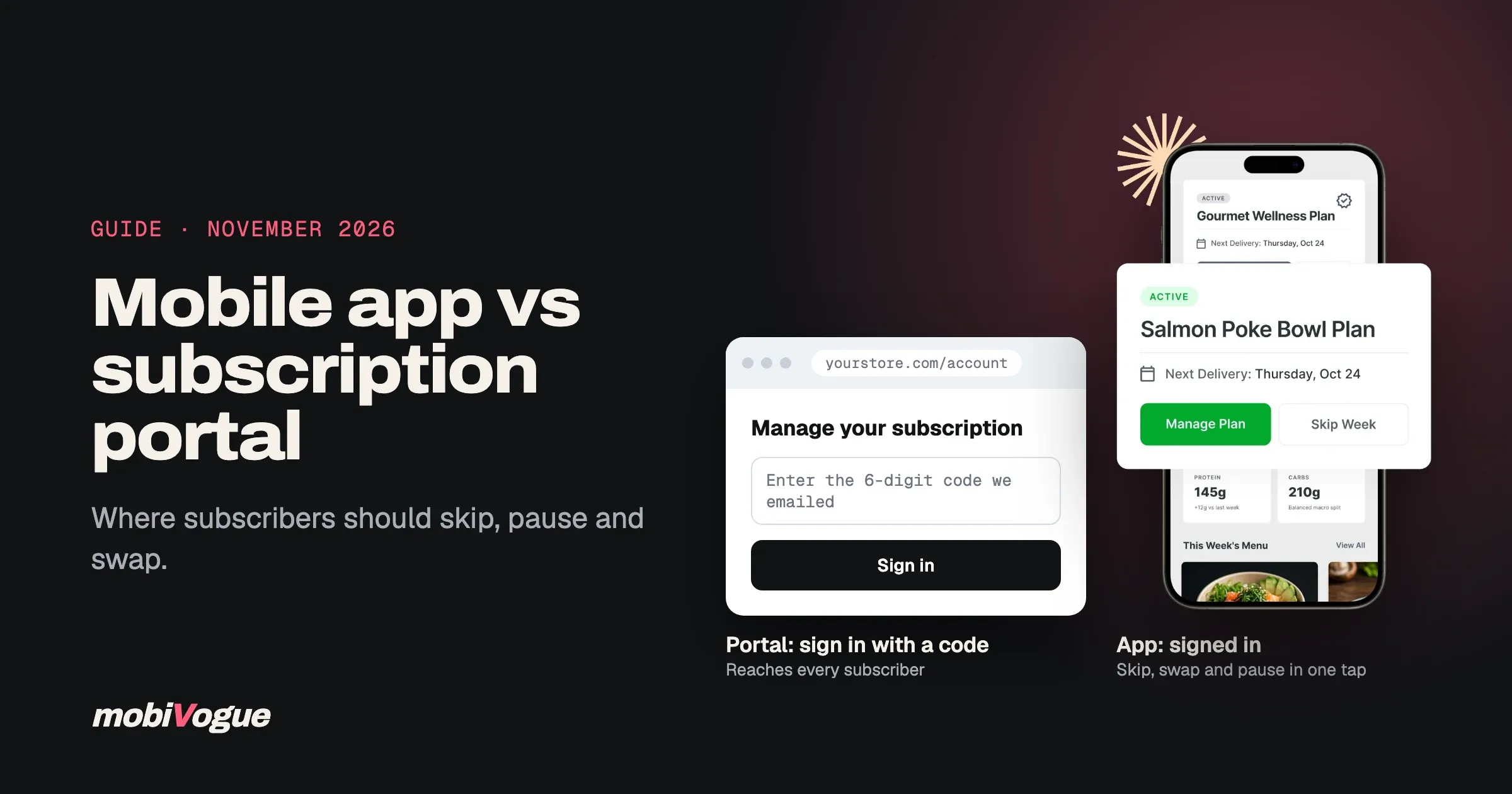
A subscription portal is your subscription app’s web page, reached from an email or your store account. Most now sign in with a one-time code, and Recharge and Skio let subscribers skip by text. An app keeps them signed in, with skip, swap and pause one tap away and a push before each renewal, but reaches only installers.
Portal, SMS and app compared
Subscribers can manage a Shopify subscription in three places: the web customer portal, text messages, and your own app. They aren’t rivals. Each reaches different people at a different moment, and most brands should run more than one.
| Web customer portal | SMS management | Mobile app | |
|---|---|---|---|
| Who it reaches | Every subscriber with an email address | Subscribers who opted in to texts | Subscribers who installed the app, an estimated 5–15% of repeat customers; for push, those who allowed notifications, about half |
| Install needed | No | No | Yes |
| Sign-in | A one-time code or magic link, or the store account; links last 10 minutes to 7 days | None for replies | Once, then stays signed in |
| Before each charge | Email reminder, often 3 days ahead | Text reminder, often 3 days ahead; reply to act | Push; in MobiVogue, 3 days ahead by default, opening on “Skip next order” |
| Skip, pause, swap | The full set your subscription app offers | Skip and delay with Recharge, Skio and Appstle; SkioSMS also swaps, pauses and adds products | Native screens or the portal inside the app, depending on the builder and subscription app |
| Cancel and retention offers | Your subscription app’s own cancel flow | Skio sends cancels to the portal; Recharge offers a delay first | Varies by builder; in MobiVogue, two taps, with skip, pause or frequency beside an equally clear cancel |
| Card update | Yes | A link to the portal | In MobiVogue, opens the subscription app’s secure card page |
| Cost to you | Included with the subscription app | Recharge Concierge $0.03 per US message; SkioSMS included; Appstle replies need Postscript or Klaviyo SMS | An app builder’s monthly fee, plus Apple’s $99 a year and Google’s $25 once; no fee per push |
| Best for | Everyone, always | Quick skips at the renewal moment | Frequent buyers who shop and manage in one place |
Checked 23 November 2026. Portals and SMS: vendor help pages linked in the next two sections; Recharge pricing. Installs: Eightx (24 May 2026, advisory estimate). Push opt-in: Airship medians of 48.85% on iPhone and 53.3% on Android in 2025 (Airship 2026 benchmarks, vendor data).
What a 2026 portal actually does
The old complaint about portals was the password. That’s mostly gone. Recharge, Skio and Shopify Subscriptions sign subscribers in with a one-time code, and Recharge’s Unity portal and Loop’s portal sit inside Shopify customer accounts. Some portals also run by text. Here’s what each one offers, from its own help pages.
| Subscription app | Portal sign-in | Link or code lasts | Manage by text | Reminder before a charge | In a MobiVogue app |
|---|---|---|---|---|---|
| Recharge | A 4-digit code by email or text, on all plans; Unity portal inside Shopify customer accounts | Not stated | Concierge SMS: plain-language replies to skip or postpone; not on the entry plan | Not stated on the pages we could open | Native screens |
| Skio | A 4-digit email code or magic link; a text code where a phone number is on file (US, Canada) | 10 minutes | SkioSMS, included: skip, pause, change date, swap, add products | Text 3 days before, once SMS is on | Its portal, opened in the app |
| Loop | Shopify customer accounts with an email code, or Loop’s magic-link page | Not stated | One-click skip or delay links inside Klaviyo, Attentive, Recart or Omnisend messages | Email, 3 days before by default | Native screens |
| Appstle | A magic link in subscription emails, or the store account | 2 hours | Reply SKIP, or 1 or 2 to delay 7 or 14 days, through Postscript or Klaviyo; off by default | Email, with a lead time you set | Its portal, opened in the app |
| Seal | An emailed magic link, a request-a-link page, or the store account | 7 days | Not stated | Not stated | Native screens |
| Shopify Subscriptions | Customer accounts with a 6-digit email code; no password | Not stated | Not stated | Email 3 days before each charge | The customer account page, opened in the app |
The actions are broad, too. Skio’s portal covers swap, skip, reschedule, frequency, add-ons, pause, card update and cancel with offers. Loop’s adds quantity, gifting and order merging. Seal lets each merchant switch each action on or off. Shopify Subscriptions covers pause, skip, payment, address and cancel, without swap or frequency changes listed.
The vendors also have numbers on how subscribers use them, all their own claims without a published method. Recharge says more than 4 in 5 customers prefer SMS to portal management. Loop says about 70% of subscribers visit the portal to pause, skip or cancel. Recharge calls its own SMS data early.
Sources, read 23 November 2026: Recharge passwordless docs (updated 2 November 2026), pricing, Unity changelog, Concierge SMS (updated January 2026); Skio magic links, customer guide, two-way SMS, one-way SMS; Loop customer accounts, quick actions, emails, portal page; Appstle magic link, two-way SMS (19 October 2026); Seal portal, edits; Shopify Help Center.
Why subscribers still miss the portal
Even a good portal has to be found. One merchant’s review of Seal: “It’s hard for customers to find their profile to make changes” (September 2026). Another, of Appstle: “When they want to cancel they email me” (July 2025). Subscribers search for it, too. Google suggests “[brand] subscription login”, “[brand] manage subscription” and “how to cancel [brand] subscription” for many Shopify subscription brands.
Most of this is setup, and the merchant controls it. Put the portal link in your site menu, on the account page and in every subscription email. Turn on code sign-in if your subscription app offers it. Those two changes cost nothing.
Sources: Shopify App Store reviews of Seal and Appstle; Google autocomplete, US, 23 November 2026, brand names replaced with [brand].
SMS: the strongest alternative
Text-to-manage needs no install and no sign-in, and it arrives at the decision moment. A subscriber gets a reminder before the charge and replies to act:
- Recharge Concierge SMS takes plain-language replies, such as skip or move my order to next week. Cancel requests are offered a delay first, and edge cases go to your team. It isn’t on Recharge’s entry plan and costs $0.03 per US message.
- SkioSMS is included with Skio. Subscribers text to skip, pause, change the billing date, swap or add products. A cancel request sends a link to the portal, so Skio’s cancel flow runs.
- Appstle lets subscribers reply SKIP, or 1 or 2 to delay by 7 or 14 days, through Postscript or Klaviyo, on its higher plans.
- Loop puts one-click skip and delay links in the messages you already send.
If most of your subscribers have opted in to texts, turn this on before anything else. It reaches more of them than an app will. Texts need consent, though; our push notifications vs SMS guide covers the rules and costs.
Sources: Recharge and Recharge pricing; Skio help (February 2026); Appstle help (19 October 2026); Loop help. Read 23 November 2026.
What an app adds
An app doesn’t replace the portal. It adds a few things the portal and texts can’t do on their own:
- It stays signed in. Portal links expire: after 10 minutes at Skio, 2 hours at Appstle and 7 days at Seal. A MobiVogue app signs subscribers in once with Shopify customer accounts and finds their subscription by the email they used at checkout.
- A push before each charge. In a MobiVogue app it goes 3 days before each charge by default, or 1 to 7 days if you prefer, and opens the subscription screen with “Skip next order”. There’s no fee per push.
- A push when a payment fails. It opens the subscription app’s own secure card page, for subscription apps that report failed charges. MobiVogue never handles card details.
- Subscription and shopping in one place. Subscribers manage the plan, reorder other products and get routine reminders in the same app.
- Cancel where they signed up. New York City’s rule and Massachusetts’ regulation look for cancelling through the same channel used to sign up. A subscriber who subscribed in your app can cancel there, two taps from the subscription screen. This isn’t legal advice.
With Recharge, Loop, Recurpay and Seal, MobiVogue subscribers skip, pause, reschedule, swap and change quantity or frequency on the app’s own screens. Skio, Appstle and other subscription apps open their own portal inside the app.
Sources: link lifetimes from Skio, Appstle and Seal help pages; Skadden on New York City (September 2026); Frankfurt Kurnit on Massachusetts. Product details: in-app subscriptions.
What an app doesn’t fix
- Reach. If 5–15% of repeat customers install, most subscribers never see the app. They’ll keep using email, texts and the portal, so those still need to work well.
- Failed payments. Retries and card updaters live in your subscription app and payment processor. An app can only get the subscriber to the card page faster.
- Infrequent buyers. If subscribers order every 60 to 90 days and buy nothing else, they’ll open the app four to six times a year. Eightx puts the payback line at four or more purchases a year.
- Your subscription app’s retention flow. A portal runs your subscription app’s own cancel flow and offers. MobiVogue’s cancel screen is its own: skip, pause or a change of frequency next to cancel. Your subscription app’s offers don’t show in it.
- A second sign-in, in some cases. Many builder integrations open the portal in a web view. Tapcart’s help page says that with Skio on stores without Shopify Plus, customers must log in separately. The same applies to MobiVogue for Skio and Appstle: their portal opens inside the app and may ask subscribers to sign in.
We found no independent study comparing churn, saves or skips across portal, SMS and app. Every number in this space is a vendor’s, and we have no churn data of our own to publish yet.
Sources: Eightx (24 May 2026, advisory estimate); Tapcart help, Skio (13 April 2026).
How they work together
Keep the portal as the system of record. In a MobiVogue app, every screen reads the subscription live from your subscription app, and every change writes straight back. MobiVogue keeps no copy, so the app, the portal and Shopify always show the same next order.
Your subscription app’s emails keep going out to everyone, app users included. If you also send a text reminder, space the two out: the app push can go anywhere from 1 to 7 days before a charge, so a subscriber doesn’t get both on the same day. When someone cancels in the app, they can give an optional reason, which is passed to your subscription app where its system accepts one.
See how this lowers churn in practice in how to reduce subscription churn, and work out your own numbers with the subscription churn calculator.
What we’d do
Our recommendation
- Keep the portal for everyone. Link it from every subscription email and from the store account, and turn on code sign-in if your subscription app offers it.
- If many subscribers have opted in to texts, turn on text-to-manage before anything else.
- Add an app when subscribers order at least four times a year and buy more than the subscription. Then it gives them one place to skip, swap, reorder and get a reminder before each charge. The payback calculator shows whether you’re there.
- Check what “integration” means before you buy an app. Native screens, or the portal in a web view with a second sign-in? Ask for each subscription app you use.